.svg)

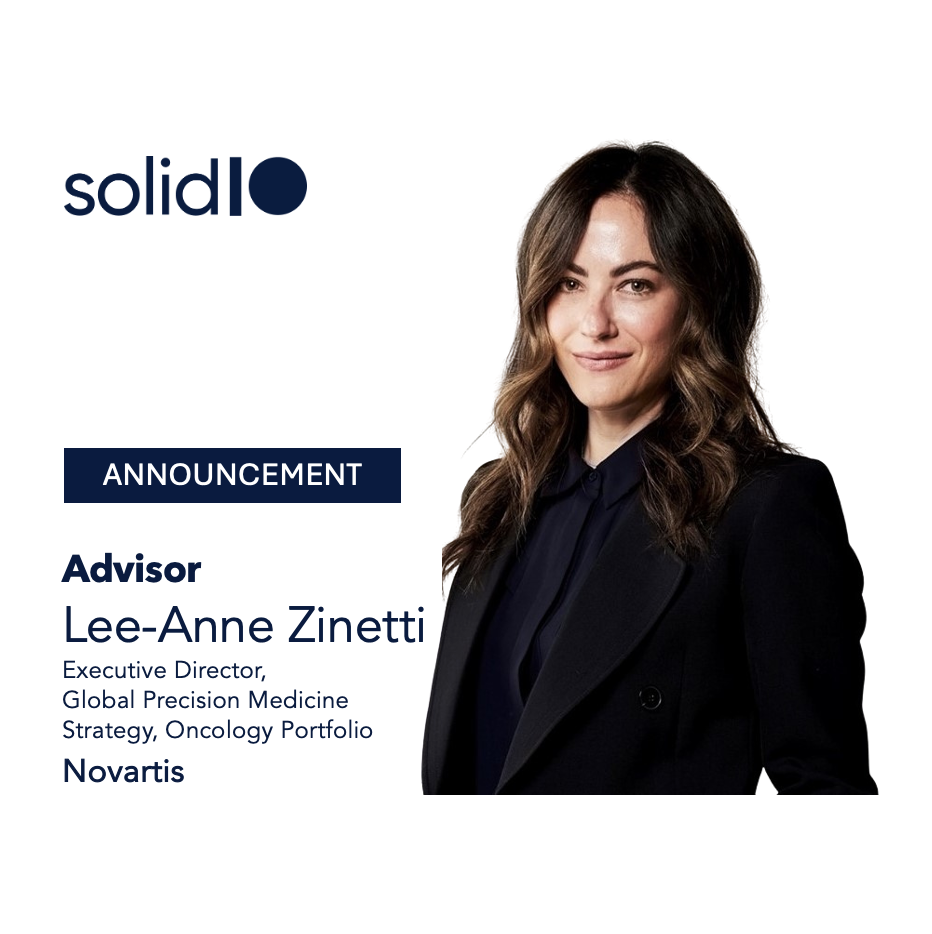
Lee-Anne Zinetti joins Solid IO’s Advisors
We are pleased to welcome Lee-Anne as an advisor to Solid IO, supporting our work with pharmaceutical and biotechnology partners and the commercialization pathway of diagnostics.
Lee-Anne currently serves as Executive Director of Global Precision Medicine Strategy for the Oncology Portfolio at Novartis, based in New York. Her work has focused on how emerging diagnostic and data-driven solutions are evaluated, validated, and integrated into pharmaceutical and biotechnology collaborations, and how they progress toward clinical and commercial implementation. She brings a portfolio-level perspective on strategic positioning, partnerships, and market- and system-level decision-making in global oncology.
Previously, Lee-Anne has held multiple senior global roles at Novartis and QIAGEN, with responsibility spanning commercialization, strategic partnerships, and international market entry. Her experience offers a practical and highly relevant view into how pharma and biotech organizations engage with new diagnostic platforms and what drives successful collaboration.
In recognition of World Cancer Day, we spoke with Lee-Anne about how pharmaceutical companies evaluate new diagnostic technologies, how collaboration models are formed, and what determines whether a platform ultimately makes it into real clinical use.
When pharma evaluates the potential of a new diagnostic platform, what is the most decisive factor that technology and science teams tend to underestimate?
Alignment with a clearly defined clinical decision and value proposition, beyond technical performance alone. Even strong science struggles to progress without a clear answer to who will use it, when in the care pathway, and why it changes decisions or outcomes.
At what point does collaboration with a pharma or biotech partner create the most strategic value to a startup, and when can it begin to constrain long-term development?
The greatest value is created early, when collaboration helps shape clinical relevance, evidence generation, and regulatory strategy. It can become constraining if a platform is optimized too narrowly for a single program or asset before its broader applicability and independent roadmap are secured.
How you see the commercialization pathway of a diagnostic technology should be structured to support both scientific credibility and long-term market and patient impact?
Commercialization should be built in parallel with clinical validation, anchored in real clinical use cases, reimbursement logic, and scalable deployment. Success comes from balancing scientific rigor with early planning for access, adoption, and integration into healthcare systems – not treating commercialization as a final step.
Warmly welcome, Lee-Anne!

Shape the future of cancer care
Join us in transforming cancer care with groundbreaking organ-on-chip technology. We’re calling on researchers, clinicians, and investors to partner with us in advancing precision medicine, accelerating innovation, and expanding global access to personalized oncology. Together, we can bring clarity and better outcomes to cancer care worldwide.