.svg)

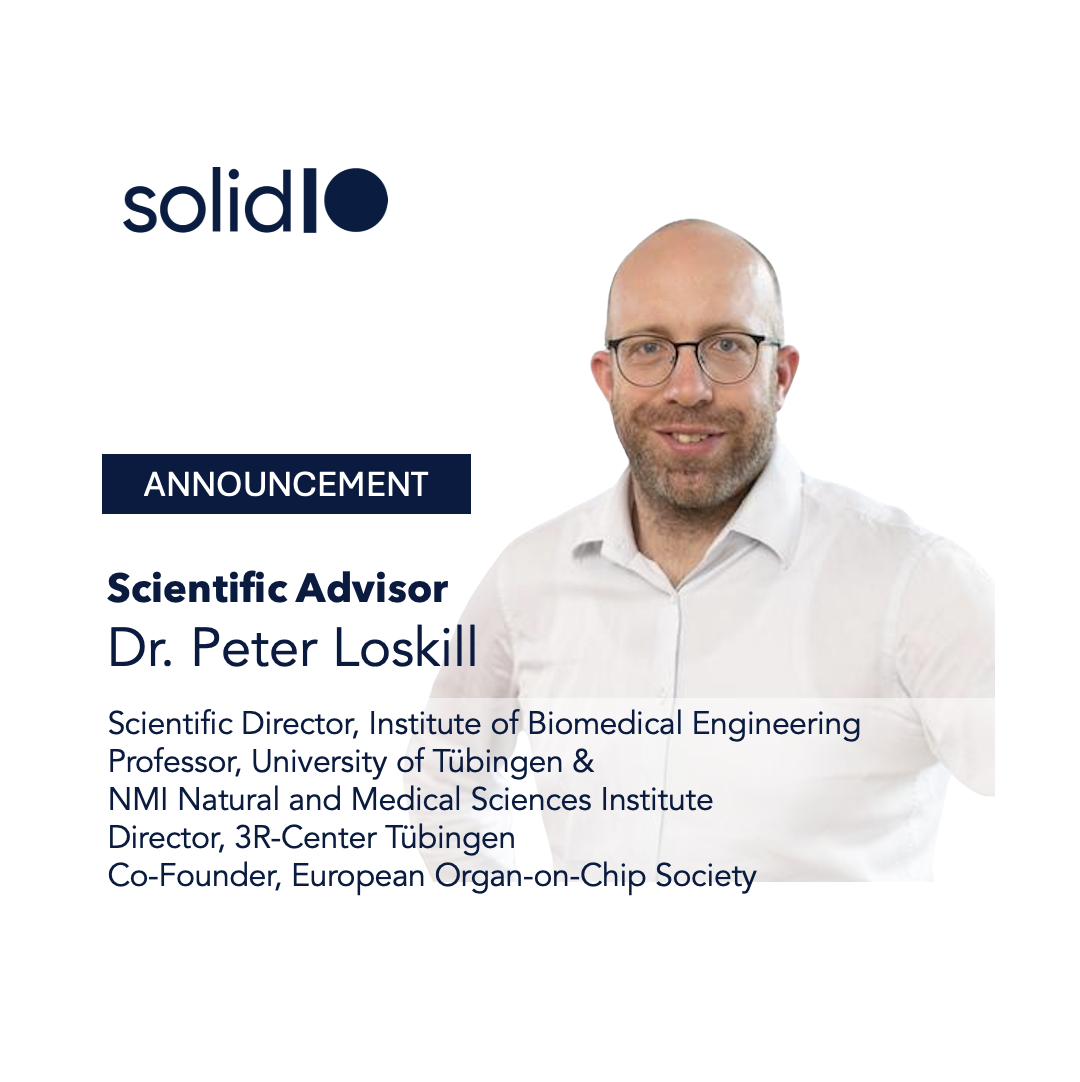
Dr. Peter Loskill joins Solid IO as Scientific Advisor
The pioneer in organ-on-chip systems supports Solid IO in bringing human biology into clinical use.
Dr. Peter Loskill joins Solid IO as Scientific Advisor, strengthening our work in predictive medicine. Professor Loskill is Scientific Director of the Institute of Biomedical Engineering (IBE) and Full Professor at the University of Tübingen and the NMI Natural and Medical Sciences Institute, Director of the 3R-Center Tübingen, and Co-Founder of the European Organ-on-Chip Society (EUROoCS). His research focuses on advanced microphysiological platforms that replicate human tissue environments with high biological relevance. With over 80 peer-reviewed publications, his work has defined the field.
“Peter has been one of the people shaping the organ-on-chip field from its early stages. His work combines engineering, biology, physics, and medicine in a way that is directly relevant to what we are building at Solid IO. We are developing patient-derived tumor models that preserve key features of human biology and produce data that can be used to guide treatment decisions. Peter’s experience in building and validating microphysiological systems brings exactly the kind of scientific perspective we need as we move this work toward clinical use.”
— Heidi Haikala, CSO, Solid IO
We asked Peter to share his perspective on how these systems can be applied in practice and what motivated him to join Solid IO's journey:
How can tumor-on-chip models improve the accuracy and clinical validity of predictive models?
Tumor-on-chip models improve predictive accuracy by using patient-derived cells to recreate an individual’s tumor environment, including cell interactions and drug responses. This makes it possible to test therapies in conditions that closely mimic the patient’s biology, capturing heterogeneity and resistance mechanisms, so predictions are more personalized, clinically relevant, and actionable.
What is required to effectively translate data from microphysiological systems into clinical decision-making?
Effectively translating data from microphysiological systems into clinical decision-making requires robust validation against patient outcomes to prove predictive value, along with standardized protocols to ensure reproducibility across labs. It also depends on integrating these data with clinical workflows such that results are interpretable and actionable for clinicians. Finally, regulatory acceptance and clear evidence of clinical utility are essential for real-world adoption.
What motivated you to join Solid IO’s journey?
The right combination of a highly relevant medical need, an excellent scientific basis as well as an agile and enthusiastic team.
A warm welcome, Peter!

Shape the future of cancer care
Join us in transforming cancer care with groundbreaking organ-on-chip technology. We’re calling on researchers, clinicians, and investors to partner with us in advancing precision medicine, accelerating innovation, and expanding global access to personalized oncology. Together, we can bring clarity and better outcomes to cancer care worldwide.